The Arrival of the Chilli.
Before 1505, the island's heat came from black pepper.
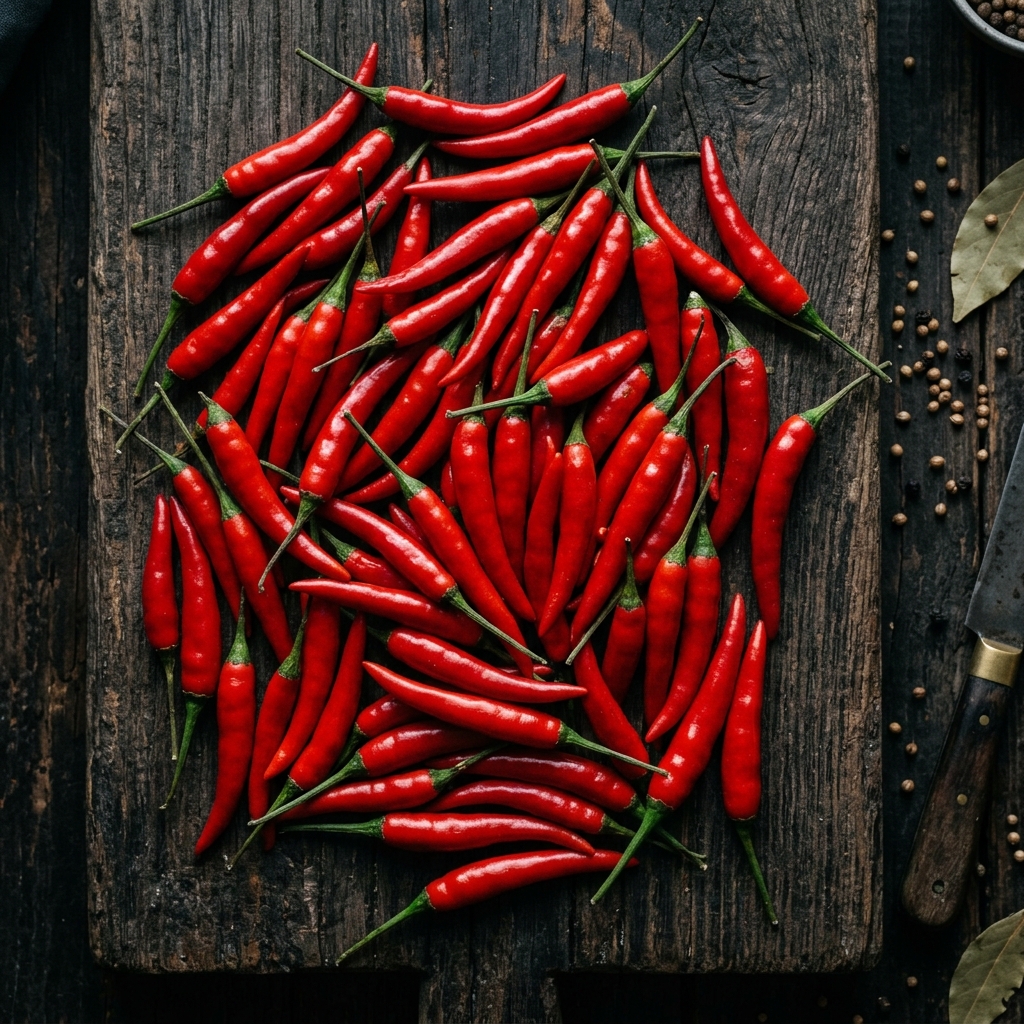
Stand in any Sri Lankan kitchen today and the chilli's presence is overwhelming — its colour, its fragrance, its heat permeating everything from the morning kola kanda to the evening dhal. It seems inconceivable that this ingredient was absent from the island's cooking less than 530 years ago. Yet that is precisely the case. The chilli pepper is a New World plant, native to the Americas, and it arrived in Sri Lanka only when the Portuguese navigator Lourenço de Almeida made landfall on the island's western coast in 1505.
The Pre-Chilli Kitchen
Before the Portuguese arrived, the heat in Sri Lankan cooking came primarily from black pepper (Piper nigrum). Sri Lanka, positioned at the heart of the ancient Indian Ocean trade routes, had been exporting black pepper for thousands of years. The spice appears in Roman records, Arab trade manuscripts, and Chinese sailing logs. It was one of the primary reasons the island attracted colonial attention in the first place.
The pre-Portuguese Sri Lankan kitchen was not bland — it was complex. Long pepper, black pepper, ginger, turmeric, mustard seeds, and a variety of aromatic leaves and barks created dishes with depth and warmth. But the particular searing, immediate heat that defines modern Sri Lankan curry — that was absent. The flavour profile of Hela cuisine before 1505 would have been almost unrecognisable to modern palates.
Capsicum annuum and the Columbian Exchange
The chilli pepper belongs to the genus Capsicum, and its most widely used species — Capsicum annuum — was domesticated in Mexico and Central America thousands of years before European contact. When Columbus arrived in the Caribbean in 1492, he encountered chillies being used extensively by Indigenous populations. Mistaking them for a form of pepper (pimenta in Portuguese and Spanish), he brought them back to Europe, setting off one of history's most dramatic food revolutions: the Columbian Exchange.
Within decades, Portuguese traders — the most aggressive maritime explorers of the era — had carried chillies along their established trade routes to West Africa, India, and Southeast Asia. By the time Almeida arrived in Ceylon in 1505, chillies had already been circulating in coastal India for several years. Their introduction to Sri Lanka was almost immediate.
The Rapid Adoption
What is remarkable is not just that the chilli arrived, but how quickly it was adopted. Unlike many introduced ingredients that take generations to integrate into local cuisines, the chilli spread through Sri Lankan cooking at extraordinary speed. Within a century, it had largely displaced black pepper as the primary source of heat in everyday cooking.
Several factors explain this rapid adoption. Chillies are easily grown in tropical conditions and could be cultivated by ordinary households, unlike black pepper which requires specific growing conditions and considerable care. The chilli's heat is also more immediate and adjustable — a dish can be made hotter or milder simply by controlling the quantity of chilli used, making it a highly flexible ingredient for diverse contexts.
The Transformation of Hela Cuisine
The introduction of the chilli did not simply add heat to Sri Lankan food. It fundamentally restructured the flavour architecture of the entire cuisine. The characteristic red colour of Sri Lankan curries — from the deep crimson of a chicken curry to the brick-red of a pol sambol — is entirely a product of the chilli. The layered heat that builds slowly through a meal, the endorphin response that makes spicy food satisfying, the way the chilli amplifies other spice flavours: all of this entered Sri Lankan cooking after 1505.
Today, Sri Lanka grows dozens of chilli varieties suited to its specific climate and culinary needs. The beloved Kanthari mulagu — a small, fierce, almost spherical chilli grown in the North — is used primarily by Tamil communities. The milder, larger varieties grown in the South are used in curry powders and sambols. Each region has developed its own relationship with the ingredient that arrived barely five centuries ago.
It is a reminder that what feels most fundamental about a cuisine — its heat, its colour, its character — is often the product of historical accident, colonial contact, and the extraordinary human capacity to absorb, adapt, and make entirely their own whatever the world delivers.