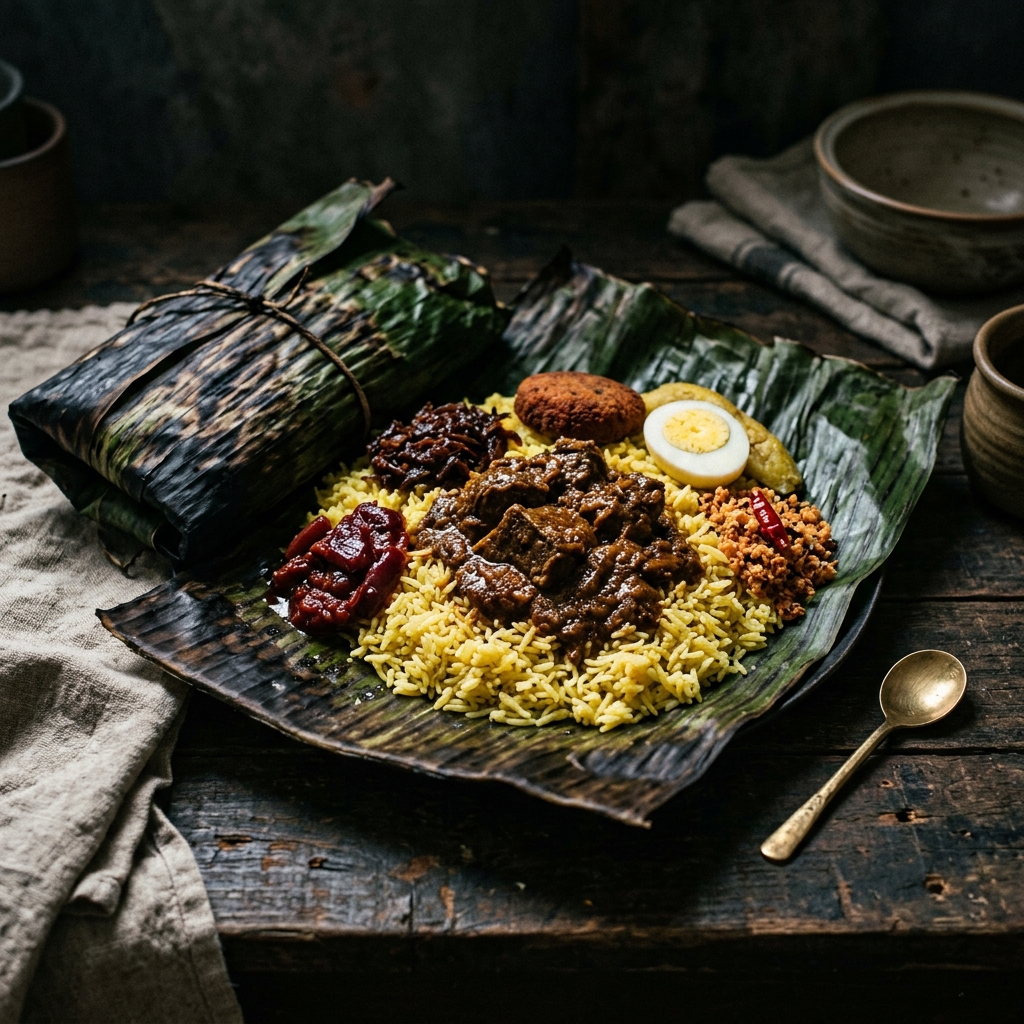
Lamprais: The Dutch Legacy.
A 17th-century masterpiece baked in a banana leaf.
There are few dishes in the Sri Lankan culinary canon as historically layered, as labor-intensive, or as deeply satisfying as Lamprais. The name itself — derived from the Dutch lomprijst, meaning "a parcel of rice" — announces the dish's colonial origins. Yet what arrives at the table is anything but a foreign imposition: it is a synthesis, a testament to five generations of Burgher cooks who took Dutch ingredients and techniques and transformed them into something entirely Sri Lankan.
Who Were the Burghers?
The Dutch Burgher community descends from the Dutch and other European settlers who arrived in Ceylon during the era of the VOC (Dutch East India Company, 1640–1796). Unlike many colonial powers who maintained strict social separation, the VOC employees frequently married or lived with local Sinhalese and Tamil women. The children of these unions — and their descendants — came to form a distinct community: the Dutch Burghers. By the 19th century, they had developed a unique cultural identity, speaking a form of Dutch-influenced English at home and maintaining culinary traditions that blended European and Asian influences.
It was in the kitchens of Dutch Burgher families in Colombo, Kandy, and Galle that Lamprais was refined into its current form over the course of two centuries.
Anatomy of a Lamprais
What makes Lamprais extraordinary is its complexity. A proper Lamprais is not a single dish but an assembly of five or six distinct preparations, each requiring significant skill, all unified by the banana leaf wrapping and the baking process.
The rice is the foundation. It is not plain steamed rice but rice cooked in a rich meat stock — typically made from beef or mutton — with whole spices: cardamom, cloves, cinnamon, and pandan. The result is a fragrant, slightly sticky rice with a depth that plain rice cannot match.
Alongside the rice come the accompaniments. A mixed meat curry — traditionally a combination of beef, pork, and mutton — is slowly braised in coconut milk until the meat is tender and the gravy is concentrated. Seeni sambol (caramelised onion relish) is cooked for up to two hours until deeply sweet and jammy. Blachan (a dried shrimp paste preparation) adds a pungent umami counterpoint. And frikkadels — Dutch-influenced meatballs made from minced meat, bread, and spices — complete the assembly.
Everything is wrapped tightly in a banana leaf, which is then folded and oven-baked. The banana leaf does more than just contain the food: it infuses the entire parcel with a subtle, grassy, slightly smoky fragrance that is inseparable from the dish's identity.
The Technique of Wrapping
The wrapping of a Lamprais is itself a skill passed down within Burgher families. The banana leaf must be softened first — either over a flame or by briefly immersing it in boiling water — to make it pliable without tearing. The rice is placed in the center, the accompaniments arranged around it in a specific order (traditionally with the frikkadels and curry on top), and then the leaf is folded in overlapping layers, like a parcel, and secured. Some families use a second outer wrapping for added security during baking.
The final baking in a moderate oven for 30-45 minutes steams the contents within the sealed leaf package, allowing the flavours to meld while the leaf imparts its signature character.
Lamprais in Contemporary Sri Lankan Cooking
Today, Lamprais is served at Burgher community events, high-end Colombo hotels, and a handful of specialist restaurants that maintain the traditional recipe. It is not everyday food — the preparation can take an entire day — but it is the dish that most completely tells the story of Sri Lanka's Dutch colonial history and the community it created.
Efforts to simplify or shortcut the recipe are generally frowned upon within the Burgher community. The dish's complexity is its integrity. To make a proper Lamprais is to perform an act of cultural memory.